
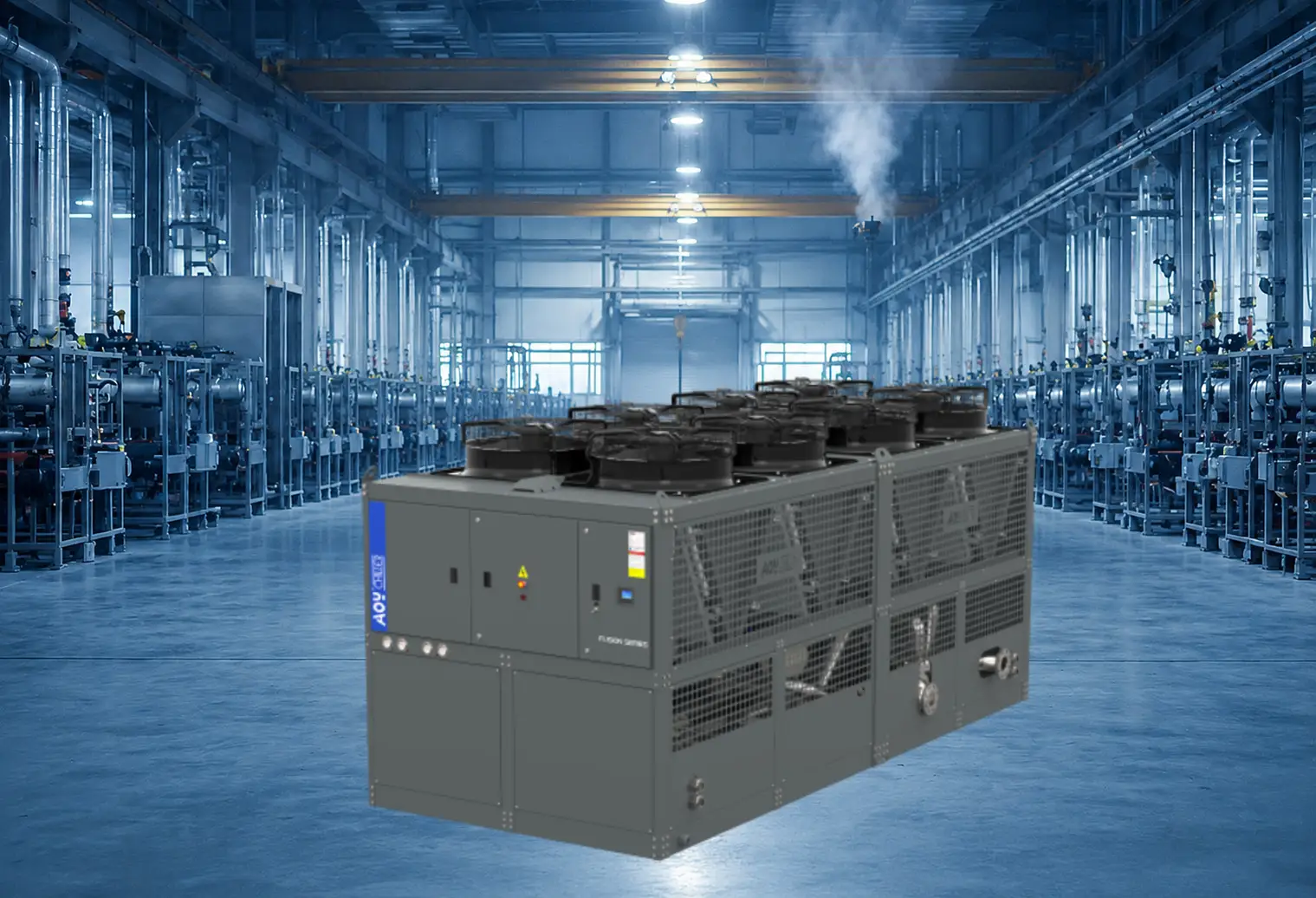
What Is a Water-Cooled Chiller?
As the name suggests, water-cooled chiller systems are units that cool the hot gas in the condenser using the high heat transfer capacity of water rather than air fans.
In this system, the operating principle runs through a shell-and-tube or plate-type condenser heat exchanger. The hot gas coming from the compressor condenses thanks to the cool water circulating in the heat exchanger. This heated water is sent to a separate unit, the cooling tower, where it is cooled in the atmosphere and returns to the condenser. Because water is a much more efficient conductor of heat than air, these systems are preferred especially at very high capacities (usually 400–500 kW and above) and in cramped plant rooms.
Water-Cooled vs. Air-Cooled Chillers
The question businesses at the investment stage ask most often is undoubtedly: "Should I choose a water-cooled or an air-cooled chiller?" There is no single right answer. It depends on your facility's physical conditions and energy goals.
The main difference between the two systems lies in how heat is rejected and the efficiency values that result:
- Energy Efficiency (COP): Thermodynamically, water is a much better heat carrier than air. Water-cooled chillers therefore do the same cooling work as air-cooled models with lower electricity consumption. Because the condensing temperature depends not on the outdoor dry-bulb temperature but on the lower wet-bulb temperature, loss of performance in summer is minimal.
- Location and Space Requirements: Air-cooled units need to be outdoors (on the roof or in the yard) to breathe and take up a lot of space. Water-cooled units, on the other hand, can be installed indoors (in plant rooms or basements), with only a cooling tower, which takes up less space, outside.
- Maintenance: Air-cooled systems are simpler to maintain; cleaning the condenser coils is enough. In water-cooled systems, however, regular chemical treatment is needed against scaling and bacteria in the cooling tower.
If your facility has no water problems, you have a maintenance team and your priority is maximum energy savings, a water-cooled system is better; if you are looking for easy installation and low maintenance effort, air-cooled systems are more suitable.
Advantages of Water-Cooled Chiller Systems
Although the initial purchase cost is an important criterion in an industrial investment, what really determines profitability is the total cost of ownership (TCO). Although water-cooled chiller systems require a cooling tower and pump set at installation, they quickly pay back this cost through the return they deliver in operation. Especially in factories running 24/7 and with high cooling loads, the advantages of water-cooled chillers show clearly in the electricity bill and in production continuity.
High Energy Efficiency
It is a thermodynamic fact that water transfers heat much more efficiently than air. In water-cooled systems, the condensing temperature depends not on the outdoor dry-bulb temperature (air temperature) but on the wet-bulb temperature. This allows the system to work at much lower pressures.
When the compressor uses less power to compress the gas, electricity consumption (kW) drops significantly. Compared with an air-cooled system, a water-cooled chiller can use 20% to 30% less energy to do the same cooling work. On an annual basis, this efficiency means huge savings in operating costs. With energy costs constantly rising, water-cooled chiller systems are the technology that offers the highest EER (Energy Efficiency Ratio) and COP (Coefficient of Performance) values.
Longer Equipment Life
Because of the way they work, water-cooled chillers are usually installed inside a building (in a plant room or basement). This protects the unit from harsh outdoor effects such as rain, snow, direct sunlight, dust storms and extreme temperature changes. In addition, thanks to the stable condensing pressure water provides, the compressors run in a more balanced regime without being overstrained. Less mechanical stress and a clean indoor environment extend equipment life by years compared with air-cooled equivalents.
Stable Performance at Large Capacities
The biggest handicap of air-cooled systems is that when the outdoor temperature rises sharply (for example 40°C and above in summer), cooling efficiency drops or the unit goes into protection mode because of high pressure. Yet industrial production has to continue summer and winter alike.
Perhaps the most critical advantage of water-cooled chillers is this stability. However hot it is outside, the water temperature in the cooling tower is always lower. As a result, cooling performance does not fluctuate even in very high-capacity facilities. In industries where a production stoppage is very costly, such as plastic injection molding, iron and steel or textiles, water-cooled systems guarantee uninterrupted production.
Which Facilities Are Water-Cooled Chillers Suitable For?
Not every cooling system suits every facility. Water-cooled chiller systems are generally ideal for large businesses where energy consumption is critical, rather than small workshops. If your facility meets one or more of the following criteria, a water-cooled system is the right engineering solution for you:
- Facilities That Need High Cooling Capacity: They are unrivaled in efficiency for plastic injection molding plants, iron and steel works, textile factories and the chemical industry, which usually need cooling loads of 400–500 kW and above.
- Businesses with Limited Outdoor Space: Air-cooled units need a large roof or yard. For city-center hotels, hospitals or factories without outdoor space, however, water-cooled units are compact enough to fit in basement plant rooms.
- Extremely Hot Regions: In regions where ambient temperatures reach 45–50°C in summer, air-cooled units can lose efficiency. Water-cooled systems are affected as little as possible by outdoor temperature and provide stable cooling even on the hottest days.
- Access to Water: If the facility has access to a cheap water source (well water, a river, etc.) or water costs are tolerable, the operating cost of this system is very low.
Do Water-Cooled Chillers Have Disadvantages?
As an engineering company we must be transparent: every technology has a price. When resolving the "water-cooled or air-cooled chiller" dilemma, investors also need to be aware of these operational responsibilities:
- Initial Investment and Installation: These systems are not just a chiller unit. They also need a cooling tower, tower pumps and more complex piping. This raises the initial installation cost somewhat compared with air-cooled systems.
- Water Consumption and Treatment: Water is the heart of the system. Because water evaporates in the cooling tower, a constant water supply is needed. More importantly, the water must be chemically treated regularly to prevent scaling, corrosion and bacteria (Legionella). A poorly maintained cooling tower can clog the chiller's heat exchanger and reduce efficiency.
- Mechanical Complexity: Because there are more parts in the system (tower, extra pumps), there is more equipment to maintain.
It should not be forgotten, however, that in high-capacity facilities the energy savings usually more than pay for these extra maintenance and water costs.
Turn Your Energy into Production with Yıldırım Soğutma
Deciding which system is most efficient for your business is not just a choice of unit but a long-term energy strategy. At Yıldırım Soğutma, instead of off-the-shelf solutions, we offer engineering calculations based on your facility's real data. Whether with our domestically manufactured AOY brand or our distributorship of the global giant Atlas Copco, we match the capacity your factory needs with the technology best suited to your budget and infrastructure.