
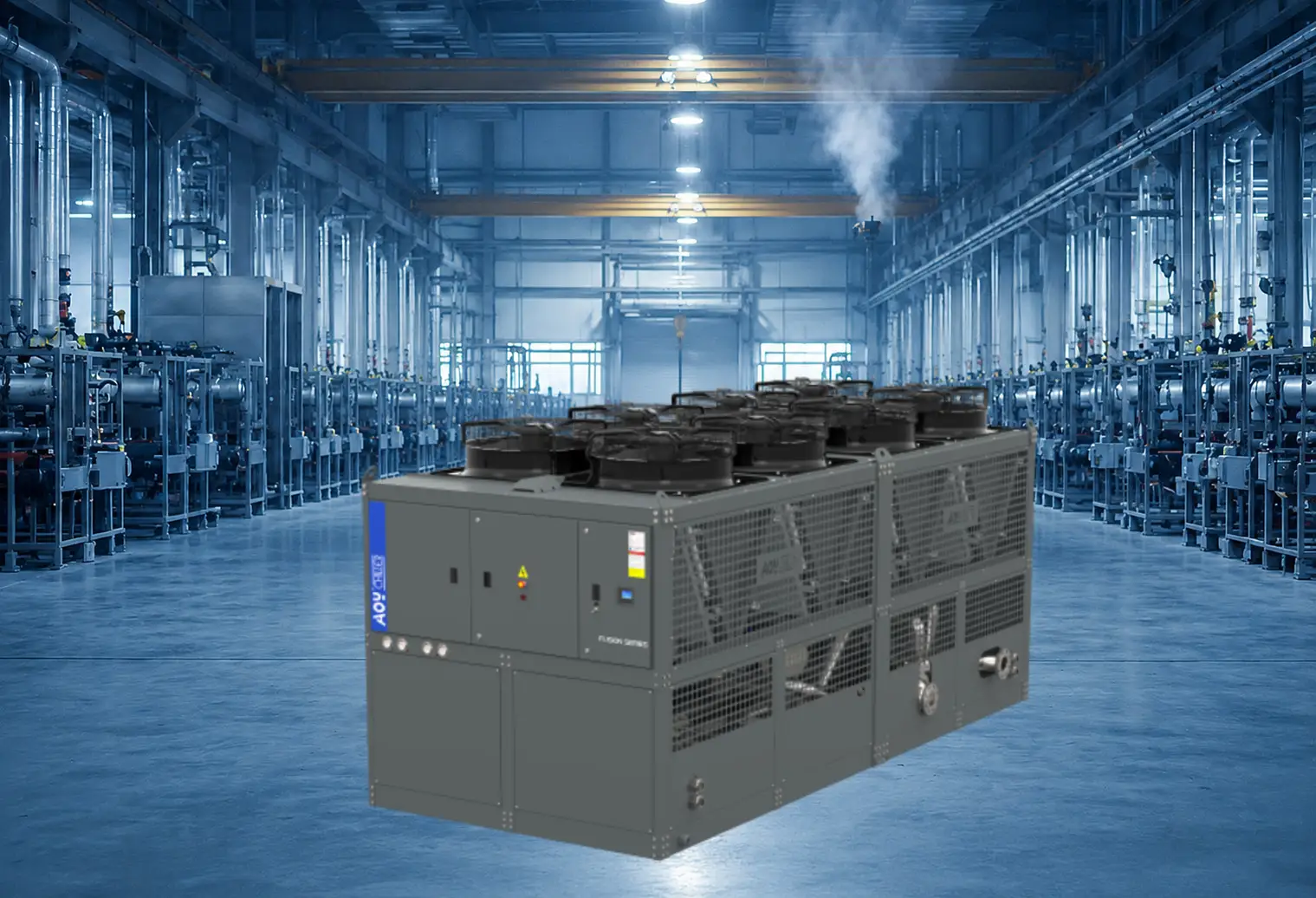
What Is a Chiller and Where Is It Used?
A chiller is an industrial cooling system that cools water or glycol mixtures and delivers them to processes to keep a facility's heat load under control. Its main purpose is to efficiently remove the heat generated on production lines and keep equipment at its ideal operating temperature. Industrial chiller systems consist of a refrigeration circuit, compressor, evaporator, condenser and control panels. Depending on the technology, air-cooled or water-cooled chiller options can be chosen.
Chiller systems have an extremely wide range of applications and are an indispensable part of many industrial processes. They play an active role in many areas, from controlling mold temperature in plastic injection and blow molding machines to extending tool life on metalworking and CNC lines. In chemical, petrochemical and pharmaceutical plants, they ensure precise management of reaction temperatures. They provide hygienic, controlled cooling on food production and packaging lines, and in galvanizing and coating processes they help keep chemical baths at the ideal temperature. They are also one of the basic components of comfort cooling in air handling units, central cooling systems and large commercial buildings.
How Is Chiller Capacity Calculated?
Determining the right chiller capacity for a facility is one of the most important steps in choosing the right equipment. A wrong chiller capacity calculation can lead to energy losses with an oversized system or temperature control problems on the production line with an undersized unit. The calculation should therefore consider many parameters together, such as the process heat load, flow rate, inlet and outlet temperatures, ambient conditions and duty cycle. The right capacity, meeting the business's real-time needs, both makes chiller selection easier and allows a sustainable, low-energy cooling infrastructure to be built in the long run.
Cooling load calculation (kW – Tons)
The first and most critical step in determining the right capacity for a chiller is to calculate the process's cooling load correctly. This value shows the total amount of heat the system must remove and is expressed in kW or tons of refrigeration (TR). The calculation basically takes into account the fluid's flow rate, the temperature difference (ΔT) and specific heat.
The cooling load is calculated with this basic formula: Q (kW) = Flow (L/h) × 4.186 × ΔT / 3600
Where:
- Flow: The amount of water or glycol mixture circulated in the process line.
- 4.186: The specific heat of water (kJ/kg·°C).
- ΔT (delta T): The difference between inlet and outlet water temperatures.
This formula gives the minimum cooling capacity the facility needs. If the required capacity is to be calculated in TR, the following conversion is used:
1 TR = 3.517 kW
In addition, processes usually involve more than just the theoretical heat load;
- ambient heat gains,
- heat from equipment bodies,
- additional heat from running machines,
- heat losses that may occur along the line
should also be taken into account. That is why a safety margin of 10–25% is commonly added to the calculated cooling load in industry.
Choosing inlet/outlet water temperatures
The target temperature range the process needs directly affects the cooling capacity and the unit's operating mode. Choosing a very low outlet temperature increases the compressor load and raises energy consumption, while choosing a temperature that is too high can adversely affect process performance.
When choosing these values, the final temperature the process needs is determined first, and then the ΔT (delta T), or temperature difference, the system can handle is calculated. In industrial applications this difference is usually chosen between 5°C and 10°C, but narrower ranges such as 3°C are also used in processes requiring high precision.
The practical calculation is done as follows:
Required capacity (kW) = Flow (L/h) × 4.186 × ΔT / 3600
To choose the right inlet/outlet temperature, three basic questions should therefore be answered:
- At what temperature does the process run stably? (For example: 20°C / 15°C)
- What is the ideal ΔT according to the equipment's design?
- How do ambient temperature and load changes affect these values?
Choosing suitable inlet/outlet temperatures not only makes it easier to get a correct chiller capacity calculation; it also provides lower energy consumption, more stable process cooling performance and longer equipment life.
Capacity tolerance according to process type
A chiller's real performance depends not only on its nominal capacity but also on its ability to adapt to the process's dynamic heat load. When determining capacity, a tolerance of 10–25% is therefore recommended depending on the type of process. The tolerance can be kept lower on production lines that run continuously and stably, while a wider safety margin is needed in processes where the heat load rises suddenly, such as injection molding, metalworking or chemical reactions. This tolerance prevents the equipment from straining under sudden load changes, makes chiller selection safer and protects the system's long-term efficiency.
Differences Between Air-Cooled and Water-Cooled Chillers
Although both systems are designed to meet process cooling needs, they differ significantly in efficiency, operating costs, installation requirements and operating conditions.
Comparison of advantages and disadvantages
An air-cooled chiller is a system that is easy to install and does not require additional water infrastructure. Because it does not need a cooling tower, pump or water line, the initial investment cost is low and maintenance is simpler, since there are no problems such as scaling, deposits or water treatment. It can be placed outdoors and, thanks to its portable and modular design, quickly integrated into many facilities. However, air-cooled chiller systems are directly affected by outdoor temperature. Performance losses can occur in summer, which can increase energy consumption. Their fans can also create higher noise levels, and at large capacities they can take up more physical space.
A water-cooled chiller, on the other hand, is a solution that offers higher energy efficiency and is preferred in high-capacity facilities. Because it is not affected by outdoor temperature, it runs stably and efficiently all year round. It can be more compact than an air-cooled model of the same capacity, and because the load on the compressor is more evenly distributed, the system lasts longer. However, the installation cost of water-cooled chiller systems is higher because they require a cooling tower, circulation pumps and additional piping. Regular maintenance is essential; if the water is not chemically treated, problems such as corrosion, scaling and biological build-up can occur. The water infrastructure also takes up more space in the facility.
Operating costs & energy consumption
In a chiller system, energy consumption accounts for most of the operating costs. Because their condensers depend directly on outdoor air temperature, air-cooled chiller models can consume more energy, especially in summer. As ambient temperature rises, the compressor load increases and the system has to run longer to maintain the target outlet temperature. By contrast, water-cooled chiller systems run more stably and efficiently all year round thanks to the low condensing temperatures provided by the cooling tower. This delivers significant energy savings in high-capacity facilities. However, because the water side has additional operating costs such as tower fans, pumps and chemical treatment, all components must be considered in the total cost calculation.
Choosing the right type for the ambient conditions
In mild and cool climates, air-cooled chiller systems generally run more efficiently because the condenser benefits continuously from natural air flow. For facilities with outdoor space, they offer a practical solution thanks to easy placement and low maintenance needs. However, in regions with high temperatures, air-cooled models can lose performance because the outdoor temperature raises the condensing pressure.
In such demanding climates, a water-cooled chiller is the better choice. Thanks to the cooling tower, condensing temperature can be controlled independently of the outdoor air, and the system runs stably even at high temperatures. For high-capacity processes in facilities running under continuous load all year round, it offers a significant advantage in energy efficiency. However, the need for water infrastructure, additional equipment and maintenance should be taken into account.
Compressor Technology (Scroll – Screw – Inverter)
The compressor is the foundation of a chiller system, and the type of compressor used directly determines the system's efficiency, capacity control and energy consumption. Clearly understanding scroll, screw and inverter compressors is therefore important for choosing the right chiller.
Scroll compressor
chillers use a compact, quiet type of compressor that compresses refrigerant through two spiral-shaped parts moving within each other without rotating. By design it has fewer moving parts, which reduces the risk of failure and keeps maintenance needs to a minimum. It is generally used in small and medium-capacity industrial chiller systems.
Screw compressor
As the name suggests, it works by compressing refrigerant between two rotating screws. It is designed for facilities that need high flow and high capacity. It delivers very stable performance in processes running continuously under heavy load. That is why it is widely used in large-tonnage air-cooled and water-cooled chiller options.
Inverter compressor
is a technology that electronically controls the compressor's operating speed. Compressor speed can be increased or decreased according to the process's instantaneous cooling demand. Delivering significant energy savings at partial loads, the inverter has become the most important component of low-energy chiller models as of 2025.
Energy Efficiency and EER/COP Values
The most reliable way to understand a chiller system's real performance is to look at the EER (Energy Efficiency Ratio) and COP (Coefficient of Performance) values, which express the unit's energy efficiency. These two values show how much cooling capacity a chiller produces for the energy it consumes.
COP is the ratio of cooling capacity to the electricity used. For example, a unit with a COP of 4 can obtain 4 units of cooling from 1 unit of electrical energy. EER is the version of the same logic calculated in BTU/h and is used especially in international technical comparisons. The higher these values, the less energy the chiller consumes. Especially under 2025 standards, inverter-controlled compressors, advanced heat exchanger designs and optimized refrigeration circuits achieve high EER/COP values and significantly reduce operating costs.
Energy efficiency depends not only on the level of technology but also on the operating environment, condensing temperature, process load and the accuracy of the chiller capacity calculation. EER/COP values are therefore critical indicators that determine not only a unit's theoretical performance but also its long-term operating costs.
Fan Technology: EC Fans, Axial Fans, Centrifugal Fans
Fans remove heat from the condenser, keeping the unit at a stable operating temperature. That is why the most popular fan types in 2025 industrial cooling technologies are EC fans, axial fans and centrifugal fans. Each type of fan offers advantages suited to different capacity ranges, air flow needs and installation conditions.
EC (Electronically Commutated)
fans are a modern fan technology known for high energy efficiency. Because the motor is electronically controlled, it can precisely adjust its speed to the load, and it has become standard in low-energy chiller models. Its quiet operation and high performance offer significant advantages in facilities that run long hours.
Axial fans
move air in a straight, horizontal flow. They are the most common type of fan in air-cooled chillers and deliver a large flow, passing a high volume of air over the condenser. They are easy to install, need little maintenance and are an efficient solution in the medium to high capacity range.
Centrifugal fans
produce high pressure by directing air from the center outwards. Because of this, they are preferred for indoor installations, duct connections or where air flow needs to be carried over long distances. Their noise level can be lower than that of axial fans, but they may require more installation space and cost.
Chiller Component Quality (Heat Exchanger, Pump, Condenser)
A chiller's performance does not depend only on its capacity or compressor; it is important to know that the three basic components that make the system work efficiently are the heat exchanger, the pump and the condenser. The quality of these components directly determines cooling efficiency, energy consumption, unit life and maintenance costs.
Heat exchanger
is the center where heat transfer takes place. Plate or shell-and-tube heat exchangers made from quality materials increase heat transfer efficiency and reduce the risk of scaling and corrosion. A poor-quality heat exchanger lowers process cooling efficiency and makes the compressor work harder, increasing energy consumption.
Pump
circulates the water or glycol mixture in the cooling circuit at the right flow and pressure. Inefficient pumps cannot provide the required flow, which can lead to fluctuations in outlet temperature. This both disrupts process stability and keeps the chiller under constant load. A quality pump offers quiet operation, long life and constant flow.
Condenser
is the part of the refrigeration cycle where the gas compressed by the compressor condenses and transfers heat to the atmosphere (air-cooled) or to tower water (water-cooled). The higher the condenser quality, the lower the condensing temperatures the unit works at and the lower its energy consumption. Fine fin structure, a large surface area and durable materials are critical criteria for an efficient condenser.
In short, the quality of components such as the heat exchanger, pump and condenser determines many factors, from the chiller's energy efficiency to its maintenance needs and even its total operating cost. When choosing a chiller, you should therefore look not only at capacity but also at the technical values and quality standards of the components used.
Installation Environment and Operating Temperature Range
Every chiller is designed for a certain ambient temperature and air/water conditions; when operated outside these values, performance can drop, energy consumption can rise or the unit can face a higher risk of breakdowns. Criteria such as the ventilation of the installation area, ambient temperature, exposure to sunlight, humidity and air circulation should therefore be analyzed correctly. The minimum–maximum operating temperature range of the chosen chiller should also suit the facility's climate and the process heat load. The right installation environment not only provides stable cooling performance but also extends the unit's life and significantly reduces operating costs.
Ease of Maintenance and Repair and the Service Network
The efficient, uninterrupted operation of a chiller depends not only on choosing the right product but also on regular maintenance and a strong service infrastructure. At Yıldırım Soğutma, we know very well how critical chiller maintenance is to ensure that energy consumption does not rise, cooling capacity does not fall and no unexpected stoppages occur in your business with systems running at full capacity all year round. That is why we place great importance on every chiller we manufacture and sell having easily accessible components and a modular design suited to quick intervention. This way, routine chiller maintenance such as filter and heat exchanger cleaning, pump checks or circuit tests can be completed in minimum time.
Our service organization is shaped with the same care. With our regional teams, we carry out fast chiller service interventions and prevent your production processes from being interrupted. Thanks to our spare parts stock management, you can get the components you need without delay, and our technical team's expertise resolves faults as quickly as possible. In addition, our regular maintenance programs help you extend your unit's life while keeping your operating costs under control.
How Do You Assess Price/Performance?
A proper price/performance analysis for a chiller is possible not just by comparing quotes but by calculating the total cost the unit will generate over its entire life cycle. The steps to follow in this assessment should be clear and measurable.
1. Compare energy consumption (EER/COP analysis)
Because energy costs have the biggest impact, the "annual energy cost" should be calculated by comparing the units' EER/COP values. Example formula: Annual energy cost = kW consumption × operating hours × electricity unit price.
Example formula: Annual energy cost = kW consumption × operating hours × electricity unit price.
This comparison may show that a unit that is more expensive at first pays for itself within a few years thanks to energy savings.
2. Calculate maintenance and operating costs.
- Filter and heat exchanger cleaning
- Pump and fan maintenance
- Chemical treatment (in water-cooled systems)
- Periodic service fees
These items add up to a significant total cost in the long run. A model with low maintenance needs saves money in operation despite its higher price
3. Assess the risk of breakdowns and the service network.
Brands with a strong service network:
- Offer shorter service times
- Don't cause spare parts shortages
- Reduce breakdown-related downtime
This indirectly reduces costs by preventing production losses.
4. Examine the quality of the components used.
The quality of the heat exchanger, compressor, fan and pump directly affects the chiller's life. Quality components = fewer breakdowns + lower energy consumption + longer service life
5. Calculate the Total Cost of Ownership (TCO).
The comparison should be made with this formula: TCO = Initial investment + 5–10 years of energy costs + maintenance/service costs + breakdown/downtime costs
6. Confirm that the performance suits the process.
Even if the whole cost assessment is correct, if the unit's:
- capacity,
- compressor type
- operating temperature range
- fan technology
does not suit your process requirements, there is no price/performance advantage
A price/performance assessment does not mean choosing the cheapest unit; it means identifying the chiller that delivers the highest efficiency at the lowest total cost. This protects the operating budget and builds a cooling infrastructure that is sustainable in the long run.
To explore suitable solutions for your facility, you can visit our Industrial Cooling Units page, and to better understand how stoppages in compressed air systems affect cooling processes, you can also read our blog post Air Compressor Not Working: The Most Common Faults and How to Fix Them.
At Yıldırım Soğutma, we bring our expertise to the field to provide the reliable, energy-efficient cooling solutions businesses of every size need in their production processes. If you want to determine the right chiller capacity for your facility, choose the right technology or make your existing cooling infrastructure more efficient, contact us.